Saturday, January 7, 2012

Astacus Astacus

Astacus Astacus
Astacus Astacus
European Crayfish
Noble Crayfish
Broad-Fingered Crayfish

Synonym :    Astacus fluviatilis

Kingdom: Animalia
Phylum: Arthropoda
Subphylum: Crustacea
Class: Malacostraca
Order: Decapoda
Family: Astacidae
Genus: Astacus
Species: Astacus Astacus


Common Name  Astacus Astacus  :
English Noble Crayfish, Broad-clawed Crayfish, Broad-fingered Crayfish, European Crayfish, Red-clawed Crayfish, Red-footed Crayfish, River Crayfish
French Écrevisse á Pattes Rouges, Écrevisse Fluviatile, Écrevisse Noble


Size Length of male: 16 cm 
Length of female: 12 cm 


Astacus (from the Greek αστακός, astacós, meaning "Lobster" or "Crayfish"/"Crawfish") is a genus of Crayfish found in Europe and western Asia, comprising three extant and four extinct species.
Due to the American crayfish plague, crayfish of this genus have been almost wiped out in Europe and have in many European countries been replaced by the North American signal crayfish, which is often more resistant to the plague


Astacus Astacus, the "European Crayfish", "Noble Crayfish" or "Broad-Fingered Crayfish", is the most common species of crayfish in Europe, and a traditional foodstuff. Like other crayfish, Astacus Astacus is restricted to fresh water, living only in unpolluted streams, rivers and lakes. It is found from France throughout Central Europe, to the Balkan peninsula, and north as far as parts of the British Isles, Scandinavia, and the western parts of the former Soviet Union. Males may grow up to 16 cm long, and females up to 12 cm.

The Noble Crayfish, Astacus Astacus, is indigenous and widespread throughout Europe. This species range extends from Russia and the Ukraine in the east, to Finland, Sweden, Norway in the north, to Greece in the south, and the United Kingdom and France in the west. A few recently introduced subpopulations are found outside Europe, for example Morocco. The occurrence of this species within Andorra, Cyprus, the UK, Liechtenstein, Luxembourg, Morocco and possibly Montenegro and Italy, is via introductions from neighbouring countries.


Astacus Astacus was once abundant in Europe, although it was expensive to buy, and is considered to be the finest edible crayfish. It is, however, susceptible to the crayfish plague carried by the invasive American species signal crayfish (Pacifastacus leniusculus), and is therefore listed as a vulnerable species on the IUCN Red List.
Documentation of the consumption of  Astacus Astacus dates back to the Middle Ages, when it was popular among the Swedish nobility, spreading to all social classes by the 17th and 18th centuries due to its ready availability. The crayfish are collected from the wild in traps, a practice which is being replaced by more intensive aquaculture of the signal crayfish in man-made ponds. The consumption of crayfish is an important part of traditional Scandinavian culture, including the crayfish party or kräftskiva, a feast to mark the end of summer


Native Astacus Astacus :
Andorra; Austria; Belarus; Belgium; Bosnia and Herzegovina; Bulgaria; Croatia; Czech Republic; Denmark; Estonia; Finland; France; Germany; Greece; Hungary; Latvia; Lithuania; Macedonia, the former Yugoslav Republic of; Moldova; Netherlands; Poland; Romania; Russian Federation (Kaliningrad); Serbia; Slovakia; Slovenia; Switzerland


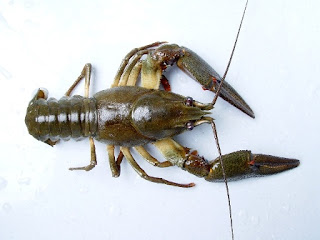
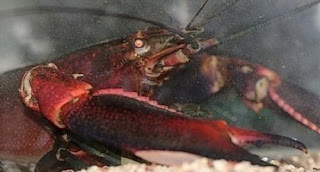
Astacus Astacus varies in colour from green or blue to brown and sometimes black. The undersides of the claws are dark red. The head and internal organs of all crayfish are protected by the carapace and the six segments of the abdomen are individually encased with a flexible membrane between them to allow movement. Crayfish have a pair of large claws at the front end, followed by four pairs of walking legs and then four pairs of small swimming legs called swimmerets. These swimmerets are covered with fine hairs to which the female attaches her eggs. A central tail flap is surrounded by four other flaps that are used to move the crayfish rapidly through the water, as well as curling up to form a brood chamber. There are two eyes on the end of eyestalks, but the senses of touch and taste are far more important, and are perceived using a pair of large feelers (or antennae) and a pair of small, fine, centrally located feelers (or antennules).

Astacus Astacus Male

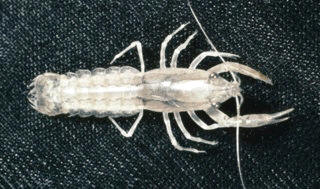
Astacus Astacus Female
The males have often longer and stronger claws than the females and the abdomen is visibly larger at the females. In order to precisely distinguish the males from the females, especially when we are talking about young crayfish or juveniles, one may verify the sternal plate and the pleopods to be sure. Male crayfish have the first couple of pleopods strong and oriented towards the front while the female has all the pleopods equal.


Astacus Astacus
Astacus Astacus

Astacus Astacus


Astacus Astacus

Thursday, January 5, 2012

Procambarus Capillatus

Procambarus Capillatus


Common Name : Capillaceous Crayfish, Alabama Crayfish, Alabama Crawfish


Kingdom :     Animalia
Phylum :     Arthropoda
Subphylum :     Crustacea
Class :     Malacostraca
Order :     Decapoda
Superfamily : Astacoidea
Family :     Cambaridae
Genus :     Procambarus
Species :     Procambarus Capillatus / Procambarus (Leconticambarus) Capillatus

Procambarus Capillatus.  Distribution: North America: Escambia River system in Alabama and Florida (Hobbs 1989). Alabama: Known only from the Escambia River system.  Habitat: Lentic environments; secondary burrower.  

Conservation Status Procambarus Capillatus : High Conservation Concern.

Type Locality
Drainage ditch adjacent to Burnt Corn Creek (Escambia River drainage) on State Route 41 northwest of Brewton, Escambia County, Alabama.

Range
Escambia River basin in Conecuh, Escambia, and Monroe counties, Alabama, and Escambia County, Florida.

Range Description : Procambarus Capillatus  is found in the Escambia River basin in Conecuh, Escambia, and Monroe Counties, Alabama, and Escambia County, Florida (Hobbs 1971).

Native Procambarus Capillatus :
United States (Alabama, Florida)

Monday, December 26, 2011

Procambarus Ablusus

Procambarus Ablusus


Procambarus Ablusus
Other Name : Hatchie River Crayfish

Kingdom: Animalia
Phylum: Arthropoda
Class: Malacostraca
Order: Decapoda
Superfamily: Astacoidea
Family: Cambaridae
Genus: Procambarus
Species:  Procambarus Ablusus /  Procambarus (Penides) Ablusus

Habitat/Native of Procambarus Ablusus : United State (Tennessee - Mississippi)

Procambarus Ablusus is found in the Hatchie River system in Hardeman, Hardin, and McNairy Counties, Tennessee, and Alcorn, Tippah, Tishomingo and Union Counties, Mississippi (Adams 2008).  Procambarus Ablusus  has a distribution of approximately 14500 km2


Procambarus Advena

Procambarus Advena

Procambarus Advena

Other Name : Vidalia Crayfish

Kingdom: Animalia
Phylum: Arthropoda
Class: Malacostraca
Order: Decapoda
Superfamily: Astacoidea
Family: Cambaridae
Genus: Procambarus
Species: Procambarus Advena

Native : United State (Georgia)

Lifespan of Procambarus Advena : 3 - 4 Years

The species was split into two taxa by Hobbs (1981), and Florida records are now considered to be for Procambarus Talpoides. As pointed out by Faxon (1884:140), the descriptions of  Procambarus Advena  and C. carolinus were transposed in Hagen's monograph, and pl. 1:figs. 51-54 and pl. 3:fig. 165 are actually of  Procambarus Advena. (see. Hobbs, 1981:311 for a detailed bibliography and explanation).

Procambarus Advena has been assessed as Least Concern. It has a fairly wide distribution, and is believed to be common within its range. Further research is needed to determine the population status of this species, and whether it is being impacted upon by any major threat processes.

This species is a regional endemic in Georgia, and occurs in three drainages with a total range of between 5000 to 20000 km2 (A. Eversole pers. comm. 2009). This species inhabits the lower coastal plain of Georgia, between the Savannah, Oconee and Altamaha rivers (Hobbs 1981). It is generally restricted to North of the Altamaha River (A. Eversole pers. comm. 2009).


Cherax SP Blue

Cherax Sp Blue / Papua Yabby / Blue Crayfish


Cherax Sp Blue
The Blue Papua Crayfish
Cherax Holthuisi 
Cherax Holthuisi Blue
Cherax Blue
Cherax Blue Knight
Blue Crayfish
Huna Biru
Lobster Biru
Papua Blue

Local Name in Papua : Huna / Huna Blue, Huna Biru, Lobster Biru
Indonesian Name : Blue Papua
Other name : Papua Yabby, Blue Papua Yabby

Kingdom:     Animalia
Phylum:     Arthropoda
Subphylum:     Crustacea
Class:     Malacostraca
Order:     Decapoda
Family:     Parastacidae
Genus:     Cherax
Subgenus:     Cherax
Species:     Cherax Holthuisi

Habitat : Papua, Irian Jaya, Indonesia and Papua New Guinea
Water Temperature : 22 - 28 derajat celcius

Size in Natural : Up to 15 gram 81–93 mm (3.2–3.7 in)

Male Large then Female

Blue / Soft Blue in Body Color

Cherax Holthuisi / Cherax Sp Blue  is a species of crayfish from the Bird's Head Peninsula in New Guinea. It grows to a total length of 81–93 mm (3.2–3.7 in). It was described in 2006 after animals circulating in the aquarium trade could not be assigned to any known species.

The total length of Cherax Holthuisi is 81–93 millimetres (3.2–3.7 in). In the wild, it is Drak Blue,Blue or soft blue, although Orange varieties are also sold in the aquarium trade. It is chiefly differentiated from the other species in the genus Cherax by the form of the rostrum, the shape of the claws and the small size of its eyes. In  Cherax Holthuisi / Cherax Sp Orange , the rostrum has two indentations on each side, and several indistinct lobes; in most other species, there are 3–8 teeth on the rostrum

Distribution and habitat
In the wild, Cherax Holthuisi / Cherax Sp Blue has only been recorded from Aitinjo Lake (1°25′28″S 132°22′22″E) on the Bird's Head Peninsula at the western end of New Guinea, in the Indonesian province of West Papua. The lake is 4 kilometres (2.5 mi) long and up to 350 metres (1,150 ft) wide, and is surrounded by steep mountains.  Cherax Holthuisi / Cherax Sp Blue  has been listed as Data Deficient on the IUCN Red List, pending better knowledge of its biology.

Specimens of  Cherax Holthuisi / Cherax Sp Blue and Cherax Sp Orange were collected in 1952, when M. Boeseman bought nine individuals from locals on the shores of Lake Aitinjo. They were deposited in the Rijksmuseum van Natuurlijke Historie (now part of Naturalis) as lots RMNH D 51503 and RMNH D 51504. The species remained undescribed, however, until Christian Lukhaup and Reinhard Pekny attempted to identify some exotic crayfish then on the market in Germany. Their specimens did not accord with any of the nine species described from New Guinea by Lipke Holthuis, but did match Boeseman's undescribed specimens. Lukhaup and Pekny therefore described the new species in a 2006 publication in Zoologische Mededelingen and called it Cherax Holthuisi in honour of Lipke Holthuis. One juvenile was later discovered among specimens described as the new species Cherax boesemani in 2008.

Wednesday, December 21, 2011

Cherax Tenuimanus

Cherax Tenuimanus Hairy

Cherax Tenuimanus Blue

Cherax Tenuimanus Black
Cherax Tenuimanus
Ausie Blue Yabby
Hairy Marron
Margaret River Marron
Blue Marron

Kingdom:     Animalia
Phylum:     Arthropoda
Subphylum:     Crustacea
Class:     Malacostraca
Order:     Decapoda
Family:     Parastacidae
Genus:     Cherax
Species:     Cherax Tenuimanus

Other Name : Cherax Tenuimanus, Ausie Blue Yabby, Hairy Marron , Margaret River Marron, Blue Marron, Blue Marron Yabby, Margaret River Yabby

Habitat :  Southwestern Australia

Water Temperature : 20 - 27 derajat celcius

pH : 5 - 8

Size in Natural : up to 2,7 Kg


Life Span : 5 - 7 years

One of the largest freshwater crayfish in the world, this hairy-shelled species has jet black pinchers and a paler olive-green to brown body. The hairy marron's (Cherax Tenuimanus) underside is brown and females have areas of red colouration on the underside and some splashes of purple. The head and internal organs of all crayfish are protected by the carapace and the six segments of the abdomen are individually encased with a flexible membrane between them to allow movement. Crayfish have a pair of large pinchers at the front end, followed by four pairs of walking legs and then four pairs of small swimming legs called swimmerets. These swimmerets are covered with fine hairs to which the female attaches her eggs. A central tail flap is surrounded by four other flaps that are used to move the crayfish rapidly through the water, as well as curling up to form a brood chamber in females. There are two eyes on the end of eyestalks, but the senses of touch and taste are far more important. These are perceived using a pair of large feelers (or antennae) and a pair of small, fine, centrally located feelers (or antennules)

Cherax tenuimanus, known as the hairy marron or Margaret River marron, is one of two species of crayfish in Southwestern Australia known as marron. It occupies a narrow range within the southwestern biogeographical region of Margaret River. It is currently listed as critically endangered on the IUCN Red List,

This species is restricted to the upper reaches of the Margaret River in the south-west of Western Australia (Morgan and Beatty 2005, Bunn 2004). This species is currently only known from 11 sites in an area less than 50 km in length (Department of the Environment, Water, Heritage and the Arts 2008). The area of occupancy (AOO) for this species is estimated to be less than 10 km² (Department of the Environment, Water, Heritage and the Arts 2008).

Can reach a mass of 2,7kg. Lateral serrations are found on each side of the rostrum and the carapace has a distinct prominence running back from the postorbital spine. The rostrum ends in a sharp spine

Sunday, November 6, 2011

Cambarellus Shufeldtii

Cambarellus Shufeldtii

Cambarellus Shufeldtii White


Cambarellus Shufeldtii / Louisiana Zwergflußkrebse / Louisiana Crayfish


Common name: Cajun Dwarf Crayfish


Kingdom: Animalia
Phylum: Arthropoda
Subphylum:Crustacea
Class: Malacostraca
Order: Decapoda
Family: Cambaridae
Genus: Cambarellus
Subgenus:  Dirigicambarus Fitzpatrick, 1983
Species: Cambarellus shufeldtii


Cambarellus Shufeldtii is a small species of crayfish native to the Southern United States. The males reach a length of about 1.5 inches (38 mm), while the females are somewhat smaller. They are easily bred in a tank, and kept by freshwater aquarists, who commonly refer to them as Cajun dwarf crayfish. Their life expectancy is 2–3 years. They are native to Texas, Louisiana, Missouri, Illinois, Arkansas, Mississippi, Alabama, Tennessee, and Kentucky.They are an introduced species in Georgia

Cambarellus Lesliei

Cambarellus Lesliei

Cambarellus Lesliei (Angular Dwarf Crawfish) / Alabama Crayfish / Alabama Zwergflußkrebse


Kingdom: Animalia
Phylum: Arthropoda
Subphylum: Crustacea
Class: Malacostraca
Order: Decapoda
Family: Cambaridae
Genus: Cambarellus
Species: Cambarellus Lesliei


Cambarellus Lesliei is a species of crayfish in the family Cambaridae. It is endemic to Alabama and Mississippi, and is listed as a species of Least Concern on the IUCN Red List.


Distribution: North America: Baldwin, Mobile and Washington counties Alabama; George County Mississippi (Hobbs 1989).
Alabama: Known from 17 database records, from Baldwin, Mobile and Washington counties in the Mobile Bay, Tombigbee and Alabama River systems.
Habitat: Streams and pools (Hobbs 1989).
Conservation Status: High Conservation Concern.

Note: In Alabama, it is illegal to stock or move any fish, mussel, snail or crayfish to any public water without a permit.

Friday, October 28, 2011

Procambarus Curdi

Procambarus Curdi


Scientific Name : Procambarus Curdi

Common Name/s : English – Red River Burrowing Crayfish

Native : United States (Alabama, Oklahoma, Texas)

Size: Adults are about 3 to 5 inches (76-127 mm) in total length.

Recognition Characters: Rostrum does not have lateral spines. Postorbital ridges terminating cephalically without spine. Cervical spine is absent or reduced to small tubercle. The acumen is narrow with two rows of punctations at its narrowest part. Branchiostegal spine is reduced as is the suborbital angle. The antennal scale is widest at mid-length. The chela is subcylindrical and long. The inner surface of the palm is tuberculate with the rest of the surface covered with punctations. The palm of the chela lacks a beard. The first pleopod of Form I male reaches the coxopodite of the third pereiopod and terminates in four distinct parts. Mesial process is noncorneous, subspiculiform, and extends beyond other terminal elements; cephalic process is noncorneous and small. The caudal process is truncate. The lamellated part of caudal process is corneous, flattened lateriomesially, and narrow with the distal margin rounded. The central projection is corneous, large, and subtrianular, and flattened lateromesially, slightly longer than the caudal process. The cephalic shoulder rounded. Annulus ventralis subovate.

Coloration Procambarus Curdi : A medium-sized brownish to rusty-brown crayfish with a cream-colored ventrolateral area of the carapace.

Habitat Procambarus Curdi : This crayfish inhabits lentic and sluggish lotic situations (Hobbs, 1989). Reimer (1975) collected the type material from burrows on the bank of the Navasota River in Texas. The burrows were about two feet deep with chimneys up to five inches in height. All burrows had only one opening. This describes the burrows of this species which were dug in the Tiak District in Oklahoma. Several burrows went down over three feet in clay substrates in pastures and roadside ditches.

General Range Procambarus Curdi : Hobbs (1989) provided the distributional range of this crayfish species as the Navasota and trinity watersheds in Texas, and the Red River basin in southwestern Arkansas and southeastern Oklahoma.

Procambarus curdi has been assessed as Least Concern. This species has a wide distribution, with an extent of occurrence of 86,000 km2, and has no known major threat processes impacting the population.

This species is known from the Navasota and Trinity river watersheds in Texas, and the Red River basin in southwestern Arkansas and southeastern Oklahoma (Reimer 1975). Procambarus Curdi has a distribution of approximately 86,000 km2.

Procambarus Curdi is a primary burrower which inhabits permanent rivers, temporary and permanent pools, and ditches (Reimer 1975, Hobbs 1990). It burrows in sandy soil but can inhabit much harsher environments (Hobbs 1990).


Procambarus Reimeri

Procambarus Reimeri


Scientific Name : Procambarus Reimeri

Native : United States (Arkansas)

Procambarus reimeri is a species of crayfish in the family Cambaridae. It is endemic to the Upper Irons Fork of the Ouachita River basin in Polk County, Arkansas

Procambarus reimeri has been assessed as Data Deficient. This species has an extent of occurrence of less than 100 km2 , and occurs in six localities. However, no major threats have been identified. Though, due to this species' restricted range and low population abundance, it is susceptible to any event which will cause habitat degradation. Further research is required to determine the abundance of this species, and to what extent it is impacted upon by threats within its range. If with further research this species is found to be impacted upon by a major threat process, it will qualify for uplisting to Endangered under criterion B.

Initially, this species was known from only 20 adults and 99 juveniles. In 2008, 52 individuals were recorded in the Ouachita National Forest (US Forest Service 2008). Evidence of viability includes dozens of individuals including juveniles at a few sites (K. Crandall pers. comm. 2009).

Recognition Characters Procambarus Reimeri : Rostrum without marginal spines and median carina. Carapace lacking cervical spine or tubercle. Areola about 20.5 times as long as broad and constituting about 37.5 percent of total length of carapace. Postorbital ridge lacking cephalic spine or tubercle. Branchiostegal spine vestigial or absent. Ischium of third periopod of first form male with simple hook overreaching basioschial articulation. First pleopods reaching coxae of third periopods, symmetrical, bearing proximomesial spur and cephalic shoulder at base of terminal elements, lacking subterminal setae but with cephalomesial row of setae along distal third to half of appendage. Terminal elements consisting of
(1) long, tapering, slightly curved mesial process extending distally beyond other terminals;
(2) small acute slightly curved, but distally directed cephalic process at cephalic base of mesial process;
(3) rather inconspicuous but composite central projection arising from between bases of cephalic, mesial and caudal processes, and closely associated with the latter; and
(4) very prominent caudal process subacute and obscuring central projection in lateral aspect and somewhat rounded distally and flattened caudally in caudal aspect.

Coloration Procambarus Reimeri : Carapace coloration pinkish cream. Dorsolateral part of branchiostegites suffused with brown; posterior part of mandibular adductor region, areola, and posterodorsal region pinkish brown. First abdominal tergum dark brick red, second through fifth terga cherry, and sixth, together with all pleura, telson, and uropods, similarly colored but suffused with tan. Cheliped pinkish cream from base to proximal half or two-thirds of merus, where becoming olive tan or brown; chela olive mesially and dorsally, and pinkish orange ventrally and laterally.

Size: Adults are approximately 3 to 5 inches (76-127 mm) in total length

Habitat Procambarus Reimeri : This burrowing species was found in roadside ditches and low wet seepage areas.

General Range: This is another Arkansas endemic crayfish confined to upper Irons Fork of Ouachita River in Polk County, Arkansas (Hobbs and Robison, 1988; Robison and Allen, 1995).

This species is a primary burrower and occurs in ditches and temporary pools (Hobbs 1979).

As this is a burrowing crayfish in a limited area, it is susceptible to habitat degradation coupled with the potential for such degradation throughout its range (Crandall et al. 2009)

Procambarus Reimeri has been given a NatureServe Global Heritage Status Rank of G1, and was assigned an American Fisheries Society Status of 'endangered', based on its restricted range and ongoing habitat degradation (Taylor et al. 2007, NatureServe 2009). Further research is on the threats to this species.

Procambarus A.Acutus

Procambarus A.Acutus


Procambarus Acutus Acutus / Procambarus A.Acutus

Common name : White River Crawfish

Size: can reach 5 inchi

Native Range: Southern Atlantic coast drainage from Georgia to Maine and from the Florida panhandle to Mexico; central Mississippi Valley to the upper Great Lakes drainages.

Recognition Characters Procambarus A.Acutus : A large dark red or brown crayfish with a blackish, wedge-shaped pattern on the abdomen and long, slender pincers. Carapace laterally compressed, its sides with a granular texture resulting from many small bunps or tubercles. Areola present, grooves separated at midpoint by a narrow space. Rostrum with a trough-like central depression, its margins strongly converging anteriorly. Acumen short, the spines or tubercles separating it from remainder of rostrum small or absent.
Male gonopod with four short processes, three of which are strongly curved laterally from midline. Processes partly obscured by hairlike structures. Gonopod tips without a prominent shoulder. Hooks present on bases of second and third pairs of walking legs. Female sperm receptacle with fossa located to right of midline and overhung by the largest of three tubercles present on surface of receptacle (Pflieger, 1996).
Coloration: Adults typically are burgundy red with a black wedge-shaped pattern on the abdomen. Tubercles on sides of the body and pincers are cream-colored. Occasionally adults are brownish rather than red. Specimens taken from turbid water are often pale colored, almost tan in coloration. Juveniles are pale gray with blackish spots laterally on the carapace and do not have a blackish wedge on the abdomen.

Size : Adults are about 3 to 5 inches (76-127 mm) in total length.

Habitat Procambarus A.Acutus : Reimer (1963) reported that this crayfish had the greatest diversity of habitat of any Arkansas crayfish. On the ONF in both Arkansas and Oklahoma, this species preferred lentic backwater habitats, but occasionally could be found in burrows at the margins of pools.

General Range: The general range of the nominate form, Procambarus acutus acutus, is from the Coastal Plain and piedmont from Maine to Georgia, from the Florida panhandle to Texas, and from Minnesota to Ohio. This form intergrades with P. a. cuevachicae in southwestern Texas and northern Mexico.

Procambarus A.Acutus has been believed to occur continuously northward along the Atlantic coastal plain into southern New England. The absence of published records, and the inability to locate specimens during recent surveys from a large portion of southwestern New England indicates a discontinuity in the northern part of the subspecies' range. Other animals and plants show a similar range discontinuity in southern New England and several theories are available to explain the phenomenon.


Procambarus A.Acutus full body


Procambarus A.Acutus Head

Procambarus A.Acutus

Procambarus Acutus Acutus Red

Procambarus Tenuis

Procambarus Tenuis

Scientific Name : Procambarus Tenuis


Common Name/s: English Ouachita Mountain Crayfish / Mountain Crayfish / Ouachita Crayfish  

Native : United States (Arkansas, Oklahoma)

Procambarus Tenuis is a species of crayfish in the genus Procambarus in the family Cambaridae. It is the only species in the subgenus Procambarus (Tenuicambarus). P. tenuis is rare throughout its range, which is restricted to the Ouachita Mountains of Le Flore County, Oklahoma and Polk County, Arkansas

Kingdom : Animalia
Phylum : Arthropoda
Subphylum : Crustacea
Class : Malacostraca
Order : Decapoda
Family : Cambaridae
Genus : Procambarus
Subgenus : P. (Tenuicambarus)  Hobbs, 1972
Species : Procambarus Tenuis

Coloration Procambarus Tenuis : Basic body coloration light tan with blackish speckles.

Size: Adults are approximately 3 to 5 inches (76-127 mm) in total length.

Habitat Procambarus Tenuis : This burrowing species has been collected from under rocks in clear cold streams, where it is apparently quite active even in very cold water (Williams, 1954). In this study P. tenuis was taken from simple burrows beneath rocks in a spring-fed runoff area in Arkansas and in spring-outflows under rocks in the Oklahoma portion of the ONF.
General Range: The range of Procambarus tenuis is the Arkansas, Ouachita, and Red River basins of eastern Oklahoma and western Arkansas (Hobbs, 1989).
Range Within Arkansas: Within the state, this Ouachita Mountains endemic species inhabits limited areas of the upper Ouachita, upper Little River tributaries (Red River drainage), and Arkansas River basins of western Arkansas.
The type locality of this species is six miles (9.6 km) east of Page and just west of the Oklahoma state line, LeFlore County, Oklahoma (Hobbs, 1950).

Procambarus Tenuis was collected four times during the study, twice in the Arkansas portion of the ONF and twice on the Oklahoma side. In Arkansas, one specimen was collected at the spring behind the Wonder House in Queen Wilhelmina State Park (Station 214) while a second specimen was taken from a roadside seepage area, 9.5 miles (15.3 km) northwest of Mena, Polk County (Station 213). In Oklahoma, two specimens of O. tenuis were found at the Billy Creek Recreation Area in the spring outflow there (Station 154) and four specimens were taken at Pipe Spring located north of Big Cedar (Station 155). These mark totally new known localities for this rarely seen Ouachita Mountain endemic crayfish. It is a very rare crayfish within the entire ONF as only eight specimens were taken in the four-year study.

Procambarus Tenuis has been assessed as Data Deficient. This species has a restricted range is uncommon in collections. However, it is unknown if it is impacted by any threats. Further work is needed to determine the extent of this species' range, it's abundance and the potential threats impacting the population before a more accurate assessment of conservation status can be made.

Procambarus Ouachitae

Procambarus Ouachitae


Scientific Name : Procambarus Ouachitae

Common Name/s: English – Ouachita River Crayfish / Ouachita Crayfish

Procambarus Ouachitae has been assessed as Least Concern. This species has a wide distribution, with an extent of occurence of 93000 km2, and has been described as abundant.

Native : United States (Arkansas, Mississippi)

Kingdom : Animalia
Phylum : Arthropoda
Subphylum : Crustacea
Class : Malacostraca
Order : Decapoda
Family : Cambaridae
Genus : Procambarus
Species : Procambarus Ouachitae

Procambarus Hayi

Procambarus Hayi

Scientific Name : Procambarus Hayi

Kingdom : Animalia
Phylum : Arthropoda
Subphylum : Crustacea
Class : Malacostraca
Order : Decapoda
Family : Cambaridae
Genus : Procambarus
Species : Procambarus Hayi

Procambarus Hayi has been assessed as Least Concern. This species has a wide distribution, is believed to be abundant and has no major threat processes impacting upon it. Further research is required to determine the abundance of this species and whether it is impacted by any major threat processes.

Range Description Procambarus Hayi : This species is found in the Tombigbee and Tallahatchie river basins in Alabama and Mississippi, and the Hatchie drainage in Tennessee (Payne 1972).

Native: United States (Alabama, Mississippi, Tennessee)

Habitat and Ecology Procambarus Hayi : This species is found in permanent sluggish streams and lentic situations such as ponds. The highest densities are found in streams which are upstream or downstream of small impoundments. Juveniles are found in masses of fine root systems along stream margins (US Forest Service 2008). In ponds, Procambarus Hayi adults use deeper water by day moving into shallow waters or even terrestrial habitats by night (Payne 1972). This species is also a secondary burrower (Payne 1972).

Procambarus Hayi (Faxon) was studied for 2 years near State College, Miss. Seasonal and temporal changes within the populations were determined from periodic field samples and laboratory observations. The known geographic range of the species was defined and its preference for lentic and sluggish lotic waters was indicated.  Procambarus Hayi  bred in spring and summer and oviposited and hatched from late summer to autumn. A study of monthly ovarian egg development confirmed the period of oviposition. Oviposition and the first juvenile molts occurred within the burrow. Upon reaching the 3rd instar, juveniles became independent of the female and entered the open water from mid-September through November. Most became adults during May and June of the following year after attaining a carapace length of 36.0 to 45.0 mm. Most crawfish reproduced 8 to 10 months after hatching, lived to reproduce again the following summer at 18 to 20 months, then died during the following autumn at approximately 24 months. A few apparently reproduced a third time and died after 36 months.

Friday, September 9, 2011

Cambarellus Texanus

Cambarellus Texanus


Cambarellus Texanus
Brazos Dwarf Crayfish
Texas Dwarf Crayfish
Texas Crayfish

Cambarellus Texanus was first found in a ditch near Bay City in Matagorda County, Texas. It has since been found in the Colorado River, Fort Bend County, and Waller County. It is thought that the range is bound by the Lavaca River and Bay on the west, though the northward and eastward range limits are not known (Albaugh and Black 1973).

Thursday, September 8, 2011

Cherax Dispar

Cherax Dispar / Slender Yabby
Male Cherax Dispar Always Fight

Cherax Dispar
Slender Yabby
Slender Crayfish
The Slender Crayfish
Australian Slender crayfish

Kingdom:     Animalia
Phylum:     Arthropoda
Subphylum:     Crustacea
Class:     Malacostraca
Order:     Decapoda
Family:     Parastacidae
Genus:     Cherax
Species:   Cherax Dispar

Habitat Cherax Dispar : Queensland - South eastern coastal, Australia

Cherax Dispar is found from Brisbane to Maryborough in Queensland, Australia. It is also found on the sand islands off the coast of southeast Queensland, including North Stradbroke Island (Bywater et al. 2008) and Fraser Island. This species is reported to be widespread in the permanent small streams of southeastern Queensland (Reik 1969). 

Wilson and an international team of researchers investigated the Australian slender crayfish (Cherax dispar). The small, lobster-like crustaceans are extraordinarily aggressive beasts, with combat often resulting in death or the loss of a limb. "When you pick them up, they'll want to take your finger off right away," Wilson said.

Sunday, September 4, 2011

CheraxSpBlackOrangeTip

Cherax Sp Black Orange Tip

Cherax Holthuisi

Cherax Sp Black Orange Tip
The Black Papua Crayfish
Cherax Holthuisi
Cherax Holthuisi Black


Local Name in Papua : Huna / Huna Orange
Indonesian Name : Black Orange Papua, Black Orange Tip, Red Fire


Kingdom:     Animalia
Phylum:     Arthropoda
Subphylum:     Crustacea
Class:     Malacostraca
Order:     Decapoda
Family:     Parastacidae
Genus:     Cherax
Subgenus:     Cherax
Species:     Cherax Holthuisi

Habitat : Aitinjo Lake, Ayam Maro River, Sorong, Papua, Indonesia
Water Temperature : 22 - 28 derajat celcius

Size in Natural : Up to 15 gram 81–93 mm (3.2–3.7 in)

Male Large then Female

Black Orange Tips  / Soft Orange in Body Color

CheraxSpBlackOrangeTip / Cherax Holthuisi is a species of crayfish from the Bird's Head Peninsula in New Guinea. It grows to a total length of 81–93 mm (3.2–3.7 in) and is typically pink, orange or yellow in wild specimens. It was described in 2006 after animals circulating in the aquarium trade could not be assigned to any known species.

The total length of Cherax Holthuisi is 81–93 millimetres (3.2–3.7 in). In the wild, it is pink, orange or pale yellow, although blue varieties are also sold in the aquarium trade. It is chiefly differentiated from the other species in the genus Cherax by the form of the rostrum, the shape of the claws and the small size of its eyes. In C. holthuisi, the rostrum has two indentations on each side, and several indistinct lobes; in most other species, there are 3–8 teeth on the rostrum

Distribution and habitat CheraxSpBlackOrangeTip / Cherax Holthuisi
In the wild, Cherax holthuisi has only been recorded from Aitinjo Lake (1°25′28″S 132°22′22″E) on the Bird's Head Peninsula at the western end of New Guinea, in the Indonesian province of West Papua. The lake is 4 kilometres (2.5 mi) long and up to 350 metres (1,150 ft) wide, and is surrounded by steep mountains. C. holthuisi has been listed as Data Deficient on the IUCN Red List, pending better knowledge of its biology.

Specimens of Cherax Holthuisi were collected in 1952, when M. Boeseman bought nine individuals from locals on the shores of Lake Aitinjo. They were deposited in the Rijksmuseum van Natuurlijke Historie (now part of Naturalis) as lots RMNH D 51503 and RMNH D 51504. The species remained undescribed, however, until Christian Lukhaup and Reinhard Pekny attempted to identify some exotic crayfish then on the market in Germany. Their specimens did not accord with any of the nine species described from New Guinea by Lipke Holthuis, but did match Boeseman's undescribed specimens. Lukhaup and Pekny therefore described the new species in a 2006 publication in Zoologische Mededelingen and called it Cherax holthuisi in honour of Lipke Holthuis. One juvenile was later discovered among specimens described as the new species Cherax Boesemani in 2008.

Cherax Sp Papuanus

Cherax Tiger or Zebra / Zebrakrebs
Cherax Sp / Cherax Papua Sp / Yellow Tiger


Cherax Papuanus / Cherax Zebra / Tiger / Yallow Tiger / Rainbow

Cherax Sp Papuanus
Cherax
Papuanus
Cherax Sp Tiger
Cherax Tiger
Cherax Sp Asia Tiger
Cherax Asia Tiger
Cherax Yellow Tiger
Cherax Papua Yellow Tiger
Cherax Asia Yellow Tiger
Cherax Sp Zebra
Cherax Zebra
Cherax Misolicus
Cherax Peknyi 
Cherax Sp
Cherax Rainbow  
Fly River
Zebrakrebs
Kingdom:     Animalia
Phylum:     Arthropoda
Subphylum:     Crustacea
Class:     Malacostraca
Order:     Decapoda
Family:     Parastacidae
Genus:     Cherax
Species:     Cherax Misolicus / Cherax Sp  / Cherax Sp Papuanus / Cherax Sp Tiger / Cherax Sp Zebra / Cherax Sp Asia Tiger / Cherax Peknyi


Local Name / Other Name : Huna  / Huna Tiger / Udang Selingkuh / Lobster Papua / Cherax Papua / Cherax Sp / Cherax Sp Papuanus / Cherax Papuanus / Cherax Sp Tiger / Papua Tiger / Tiger Papua / Zebra Papua / Papua Zebra / Cherax Misolicus/ Cherax Sp Asia Tiger / Cherax Asia Tiger / Cherax Peknyi / Cherax Yellow Tiger / Cherax Asia Yellow Tiger / Cherax Rainbow / Zebrakrebs / Fly River

Natural Habitat Cherax Zebra / Yellow Tiger : Ayam Maro River, Sorong, West Papua / Irian Jaya, Indonesia

Water temperature range : 20 - 26 °C,

PH 6.5-7.5

Cherax Yellow Tiger / Zebrakrebs is Scavenger species

Naturally up Cherax Zebra to 15 Cm in size

Cherax Zebra / Cherax Tiger Male Bigger than Female

Body Color Cherax Zebra / Yellow Tiger : Black White Yellow Orange, like Zebra or Tiger

Cherax Peknyi / Cherax Tiger / Cherax Papua / Cherax Rainbow


Cherax Papua / Cherax Papuanus / Cherax Sp

Cherax Sp Hoa Creek

Cherax Sp Hoa Creek

Cherax Sp Hoa Creek

Cherax Sp Hoa Creek
Cherax Hoa Creek
Cherax Sp
Cherax Boesemani  Hoa Creek
Cherax Boesemani


Kingdom:     Animalia
Phylum:     Arthropoda
Subphylum:     Crustacea
Class:     Malacostraca
Order:     Decapoda
Family:     Parastacidae
Genus:     Cherax
Species:     Cherax Boesemani  / Cherax Hoa Creek

Local Name : Huna  / Udang Selingkuh / Lobster Papua / Papua Hoa Creek / Cherax Papua / Cherax Sp / Cherax Boesemani / Cherax Sp Hoa Creek / Cherax Hoa Creek

Natural Habitat : West Papua / Irian Jaya, Indonesia

Water temperature range : 20 - 26 °C,

pH 6.5-7.5

Scavenger species

Naturally up to 15 Centimeters in size

Cherax Sp Hoa Creek Male Bigger than Female

Body Color Cherax Sp Hoa Creek : Blue Pink

Cherax Sp Red Brick

Face of Red Brick

Cherax Sp

Cherax Sp Red Brick


Cherax Sp Red Brick
Cherax Sp Red Chili
Cherax Red Brick
Cherax Red Chili
Cherax Sp
Cherax Boesemani Red


Kingdom:     Animalia
Phylum:     Arthropoda
Subphylum:     Crustacea
Class:     Malacostraca
Order:     Decapoda
Family:     Parastacidae
Genus:     Cherax
Species:     Cherax Boesemani Red / Cherax Sp Red Brick / Cherax Sp / Cherax Sp Red Chili

Local Name : Huna Merah / Huna Red / Udang Selingkuh / Lobster Red / Papua Red / Papua Red Brick / Cherax Papua / Cherax Sp / Cherax Boesemani / Cherax Sp Red Brick / Cherax Red Brick / Papua Red Chili / Cherax Sp Red Chili / Cherax Red Chili

Natural Habitat : Amajaru Lakes, Kais River West Papua / Irian Jaya, Indonesia

Water temperature range : 20 - 26 °C,

PH 6.5-7.5

Scavenger species

Naturally up to 15 Cm in size

Male Bigger than Female

Body Color : Red / Red Brick

Cherax Sp Blue Moon

Cherax Sp Blue Moon
Cherax Sp Blue Moon


Cherax Sp Blue Moon
Cherax Blue Moon
Cherax Sp
Cherax Boesemani  Blue
Cherax Boesemani

Kingdom:     Animalia
Phylum:     Arthropoda
Subphylum:     Crustacea
Class:     Malacostraca
Order:     Decapoda
Family:     Parastacidae
Genus:     Cherax
Species:     Cherax Boesemani  / Cherax Sp Blue Moon 

Local Name : Huna Biru / Huna Blue / Udang Selingkuh / Lobster Blue / Papua Blue / Papua Blue Moon / Cherax Papua / Cherax Sp / Cherax Boesemani / Cherax Sp Blue Moon / Cherax Blue Moon

Natural Habitat : Amajaru Lakes, in the Kais River Drainage in the centre of the Vogelkop Peninsula, West Papua / Irian Jaya, Indonesia

Water temperature range : 20 - 26 °C,

PH 6.5-7.5

Scavenger species

Naturally up to 15 Cm in size

Male Bigger than Female

Body Color : Blue

ProcambarusSpMarmorkrebs

Procambarus Sp Marmorkrebs

Procambarus Marmorkrebs
Marbled Crayfish

Procambarus sp. "Marmorkrebs"

Difficulty : Easy

Min. Tank Size : 18.9 Litres (5 US G.)

Size : 2.5-10.2cm (1-4 ")

pH : 7 - 7

Temperature : 18 -25 °C (64.4-77°F)

Water Hardness : 6-6 °d

Availability : Rare

Diet : Omnivore, Pellet Foods, Flake Foods

Life Span : 2-4 years

Alternative Names
 Marbled crayfish, Parthenogenetic Crayfish, Procambarus fallax f. virginalis, "Procambarus Marmorkrebs" (sic).

Marmorkrebs, or Marbled Crayfish, are parthenogenetic crayfish that were discovered in the pet trade in Germany in the 1990s. Marmorkrebs are closely related to the "slough crayfish", Procambarus fallax. Procambarus fallax is widely distributed across Florida, but there are no known natural populations of Marmorkrebs. Information provided by one of the original pet traders as to where they got Marmorkrebs was deemed "totally confusing and unreliable"

Marmorkrebs are the only known decapod crustaceans to reproduce by parthenogenesis. All individuals are female, and the offspring are genetically identical to the parent. Because Marmorkrebs are genetically identical, easy to care for, and reproduce at high rates, they are a potential model organism, particularly for studying development. A major drawback, however, is the long generation time (several months) compared to other research organisms.

Marmorkrebs have caused concern as a potential invasive species because only a single individual is needed to establish a new population, and they can reproduce at high rates. They have since been introduced into natural ecosystems on three continents. They have been found in the wild in Germany, Italy, The Netherlands, Madagascar, and Japan, probably through release or escape from aquaria.

Although most reports of Marmorkrebs in the wild in Europe have consisted of only single individuals, an established population has now been documented in Germany, with reports of a second population in another German locale.

The Madagascar population is growing rapidly, causing concern among local authorities.

Although there are no confirmed cases of Marmorkrebs being found in the wild in North America, they are widely distributed among hobbyists in the North American pet trade. Due to concerns about the possible damage caused by the introduction of Marmorkrebs, Missouri added them to its prohibited species list


Marmorkrebs are closely related to Procambarus fallax. A scientific paper (Martin et al. 2010) suggests marbled crayfish be considered an asexual "form" of P. fallax. This is slightly problematic, as "forms" are not often used in scientific names for animals, although the practice is common in plant names.

Marmorkrebs is suggested as a common name because it is distinctive and less likely to be confused with other crayfish with marbled colouration.

Sexing
All marbled crayfish are female and reproduce via parthenogenesis. In related species, males have distinctly different anterior swimmerets than posterior; in females, all swimmerets are very similar.

Tank Compatibility
Larger fish may eat smaller baby crayfish. These crayfish are best in species tanks as they pose a threat to bottom dwelling fish or fish that rest on the substrate during the night. They may also attack other invertebrates.

Diet
Marmorkrebs accept a wide range of food, but may have a slight preference for plant materials. They will eat sleeping or dying fish, dead fish, and meaty sinking pellets designed for crabs or Cichlids. They will also eat softer plants if they are still hungry.

Feeding Regime
Feed twice per day. If pellets get mouldy, remove them. If you see mysterious chew marks on your plastic plants or sponge filters (both have happened to me), then your crayfish are starving. Double the number of times you are feeding them or double the amount for each time, but not both.

Environment Specifics
Provide at least one hiding place for each animal, with 1-2 extra hiding places. They will need these hiding places when they moult, or other crayfish may eat them. A long skinny pot, or length of 1 inch PVC tube (with one end closed) works fine. Crayfish feel safe in very tight space. These creatures are nocturnal and will eat sleeping fish.
Marmorkrebs fare best at room temperature (about 20°C). Although they will grow faster in warmer water, they are also more likely to die.

Behaviour
They tend to dig up rooted plants, but do not use floating plants either, as they will use them to escape the tank. Seal tank thoroughly as they are good climbers and will escape and die. Weight down the top so the crayfish will not push it open. Lower water level 2 inches below black strip at top of aquarium.
Marmorkrebs are often quite mobile and visible around tanks during the day, unless they go into berry. When in berry, they rarely move or feed.

Identification
Brownish appearance with darker brown mottling. Their colour can change depending on diet, occasionally showing slight blues or greens. Many species of Procambarus are extremely similar and difficult to distinguish based on body shape.

Popular Posts

Labels

Euastacus Cherax Australia Procambarus United State Indonesia Cherax Sp Mexico Rusia Cambarellus Cambaroides Engaeus tasmania Astacopsis Astacus Cherax Holthuisi China Europe Astacoides Cherax Boesemani Korea Madagascar Papua New Guine Astacoides Betsileosensis Astacoides Madagascariensis Astacopsis Franklinii Astacopsis Gouldi Astacopsis Tricornis Astacus Astacus Astacus Leptodactylus Astacus Pachypus Cambarellus Lesliei Cambarellus Patzcuarensis Cambarellus Shufeldtii Cambarellus Texanus Cambaroides Dauricus Cambaroides Japonicus Cambaroides Schrenckii Cambaroides Similis Cherax Albertisii Cherax Albidus Cherax Bicarinatus Cherax Cainii Cherax Cairnsensis Cherax Cartalacoolah Cherax Communis Cherax Crassimanus Cherax Cuspidatus Cherax Davisi Cherax Depressus Cherax Destructor Cherax Dispar Cherax Glaber Cherax Leckii Cherax Lorentzi Cherax Misolicus Cherax Monticola Cherax NSP Rotundus Cherax Parvus Cherax Preissii Cherax Punctatus Cherax Quadricarinatus Cherax Quinquecarinatus Cherax Robustus Cherax Rotundus Cherax Rynchotus Cherax Setosus Cherax Sp Black Orange Tip Cherax Sp Blue Cherax Sp Blue Moon Cherax Sp Blue Mountain Cherax Sp Hoa Creek Cherax Sp Orange Cherax Sp Papuanus Cherax Sp Red Brick Cherax Sp Tiger Cherax Sp Zebra Cherax Tenuimanus Cherax Wasselli Cuba Dublin Bay prawn Engaeus Granulatus Engaeus Martiginer Engaeus Orramakunna Engaeus Yabbimunna Euastacus Armatus Euastacus Australasiensis Euastacus Balanensis Euastacus Bidawalus Euastacus Bindal Euastacus Bispinosus Euastacus Brachythorax Euastacus Clarkae Euastacus Claytoni Euastacus Crassus Euastacus Dalagarbe Euastacus Dangadi Euastacus Dharawalus Euastacus Diversus Euastacus Eungella Euastacus Fleckeri Euastacus Gamilaroi Euastacus Girurmulayn Euastacus Gumar Euastacus Guruhgi Euastacus Guwinus Euastacus Hirsutus Euastacus Hystricosus Euastacus Jagabar Euastacus Jagara Euastacus Kershawi Euastacus Maccai Euastacus Maidae Euastacus Monteithorum Euastacus Morgani Euastacus Neodiversus Euastacus Polysetosus Euastacus Reductus Euastacus Rieki Euastacus SP1 Euastacus Setosus Euastacus Simplex Euastacus Spinichelatus Euastacus Spinifer Euastacus Sulcatus Euastacus Suttoni Euastacus Urospinosus Euastacus Valentusus Euastacus Woiwuru Euastacus Yanga Euastacus Yarraensis Geocharax Geocharax Gracilis Iran Japan Nephrops Norvegicus Norway Procambarus Ablusus Procambarus Acanthophorus Procambarus Acutus Acutus Procambarus Advena Procambarus Alleni Procambarus Atkinsoni Procambarus Capillatus Procambarus Catemacoensis Procambarus Citlaltepetl Procambarus Clarkii Procambarus Curdi Procambarus Econfinae Procambarus Erythrops Procambarus Fallax Procambarus Marmorkrebs Procambarus Ouachitae Procambarus Paeninsulanus Procambarus Pictus Procambarus Reimeri Procambarus Sp Procambarus Tenuis Procambarus Vasquezae Procambarus Versutus Turkish procambarus Hayi

Disclaimer

This Blog is a participant in the Amazon Services LLC Associates Program, an affiliate advertising program designed to provide a means for sites to earn advertising fees by advertising and linking to amazon.com All prices are grab on post date, Please check price at stores before you checkout.

Total Pageviews